Given that the recommended automated license plate reader policy has only just been released to the public, we have not had time to thoroughly analyze its content. We plan to do so in the coming days. However, even a cursory review of the proposal reveals a few fundamental concerns:
- The policy’s definition of what constitutes a “valid law enforcement” purpose is so broadly worded that the only things these cameras cannot be used for are the handful of reasons the policy explicitly prohibits. Under the policy, ALPRs can be used for “information gathering,” the “prevention of crime,” and “ensuring the safety of the public,” with or without cause that a crime has been committed. In other words, for just about any reason.
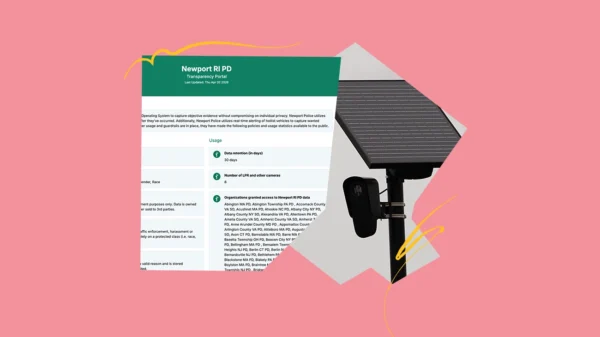
- The recommended policy allows all license plate data to be routinely maintained for up to 30 days. This ignores even Flock Safety’s recent recognition that retention of this data for a month is far too long and unduly invasive. In August, Flock Safety changed their default time frame of data retention to seven days. Any policy or law setting standards for ALPR use should not allow the information to be kept for more than that time period.
- The policy does not prevent use of the system to take photographs of drivers and their passengers, much less prohibit the use of facial recognition technology. Despite the many misleading assertions police have given that ALPRs take pictures only of the rear of motor vehicles, revelations in a recent lawsuit against Cumberland show that this is simply not the case.
- The policy claims that officers who misuse the system may be subject to criminal prosecution or civil liability. But absent a law that actually makes misuse a crime or establishes a civil cause of action, this assurance is largely meaningless.
The ACLU appreciates that the pause on further ALPR installations remains in effect, as well as some of the provisions in the recommended policy designed to establish some limits on their use. On the whole, however, the policy promises much less than meets the eye.